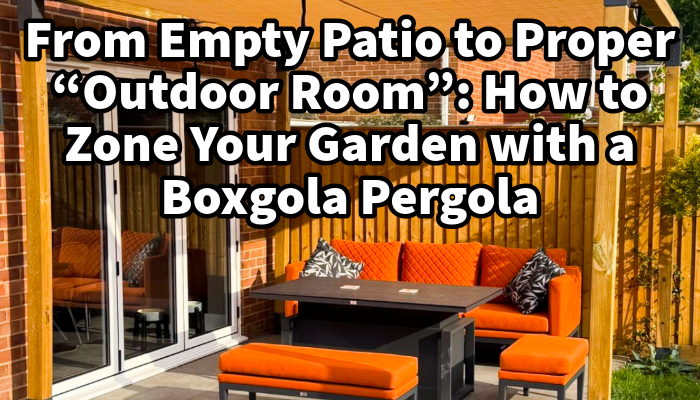
Most gardens and patios have plenty of space — they just don’t always feel like they’re designed for living in. A table gets pushed against the back door, a few chairs end up scattered about, and the area looks fine… but it doesn’t pull you outside.
That’s the difference between an outdoor space that exists and an outdoor space that gets used. When you create clear “zones” (dining, lounging, walkway, serving area), the garden becomes more like an outdoor room — practical, inviting, and easy to enjoy.
A pergola is one of the simplest ways to make that transformation. It creates an obvious structure, gives the space purpose, and instantly makes an area feel intentional. With a Boxgola Premium DIY Pergola, you get that defined layout plus weather-ready coverage and straightforward self-assembly — ideal for homes, pubs, restaurants, and any outdoor area that needs to work harder.
Garden zoning is simply the idea of giving each part of your outdoor space a job to do. Instead of one large, undefined patio, you create clear areas for specific activities — a place to eat, a place to relax, a covered area for shade and shelter, or a comfortable spot that feels private.
Why does this work so well? Because our brains like spaces with purpose. Indoors, you don’t usually put the dining table in the hallway. You naturally divide rooms based on what they’re for. Zoning does the same outdoors — and it makes even small gardens feel bigger, because the space becomes more organised and intentional.
A pergola is a natural zoning tool because it gives a “ceiling” to the space. The moment you add overhead structure, the area underneath feels like a room rather than an exposed patch of patio.
If you want one feature that instantly elevates your outdoor space, it’s a pergola. Not just for aesthetics — but because it creates structure. Instead of planning around movable furniture, you plan around something fixed and purposeful.
A Boxgola pergola works particularly well as an anchor point because it’s designed to be both practical and attractive:
Once the pergola is in place, everything else becomes easier — furniture, lighting, the flow of the space, and how people naturally use it.
You don’t need loads of space to zone a garden effectively — you just need a plan. Start by thinking about how you actually want to use the area (not how you think you “should” use it).
Here are a few zoning ideas that work brilliantly with a pergola as the centrepiece:
1) Dining zone (classic and practical)
Ideal near the kitchen or serving area, with a table and comfortable chairs. Under a pergola, it becomes a reliable spot for meals without worrying as much about sun or light rain.
2) Lounge zone (the “outdoor living room”)
Sofas, lounge chairs, coffee table, cushions — it’s about comfort. Under a pergola, this zone feels more private and far more inviting.
3) Transition zone (walkways and flow)
Even a simple pathway matters. If people have to dodge chairs to move around, the space won’t feel relaxed. A pergola can frame a walkway or lead guests naturally towards seating.
4) “Flexible” zone (useful for homes and venues)
A space that can change — extra seating when guests arrive, a place for a fire pit (where appropriate), or an area that works for events.
The key is choosing zones that match real behaviour. If you never sit at a table outside, don’t force a dining setup just because it looks good in photos.
A beautiful pergola can still feel “off” if it’s positioned awkwardly. The best outdoor rooms feel natural — like they belong exactly where they are.
A few practical principles:
For venues, flow matters even more. Guests and staff need space to move comfortably, and a pergola can help guide where queues, seating, and access routes should be.
A pergola gives you the structure — styling gives you the “finished” feeling. The trick is to make it look intentional without overcomplicating it.
A few simple wins:
For pubs and restaurants, styling can subtly shape behaviour too — people tend to stay longer in spaces that feel warm, comfortable, and thoughtfully designed.
Commercial outdoor areas often have the same challenge: lots of space, but not enough structure. When outdoor seating feels random or exposed, guests don’t settle — they hover, move around, or leave sooner.
A pergola helps venues create zones like:
The benefit isn’t just visual. A defined, sheltered area is more usable across the year, which can support better occupancy and stronger use of outdoor capacity.
Zoning is one of the most effective ways to turn an outdoor area into somewhere you genuinely want to spend time. When a space has structure and purpose, it stops being “just the garden” and becomes an outdoor room — comfortable, inviting, and easy to use.
A Boxgola pergola makes that transformation simple. It creates a clear anchor point, provides shelter, and helps the space feel finished — whether it’s for a family patio, a larger garden, or a pub garden that needs to work harder all year.
👉 Explore Premium DIY Pergolas at www.boxgola.co.uk